
On the first edge case, the mechanism matters more than the number. Flood Re does not cover commercial property, so a commercial County Durham asset in the 1-in-100 zone cannot rely on the scheme to keep cover affordable. If insurers withdraw entirely, the property's cash-flow projections lose the assumption of insurable operation, and value-in-use can fall below the 5% floor's protection — the floor was never designed to absorb a total loss of cover. The no-insurance scenario must be built as its own cash-flow case, with the resulting recoverable amount compared against carrying value on its own terms.
On the second edge case, the rule still wins. Surface-water-only risk that does not register as fluvial exposure on the Environment Agency map for the specific postcode is a narrower hazard, and the flood-zone discount evidence, once verified, is more likely to sit below the 5% floor. In that case the reserve-and-disclose treatment holds, and the impairment test is documented as performed with the indicator not escalating to a write-down.
The discipline is to record which edge case the property falls into before the recoverable-amount calculation begins, because the table determines whether the 5% floor is even the right test. A file that applies the floor to a no-insurance commercial asset has applied the wrong rule to the right indicator.
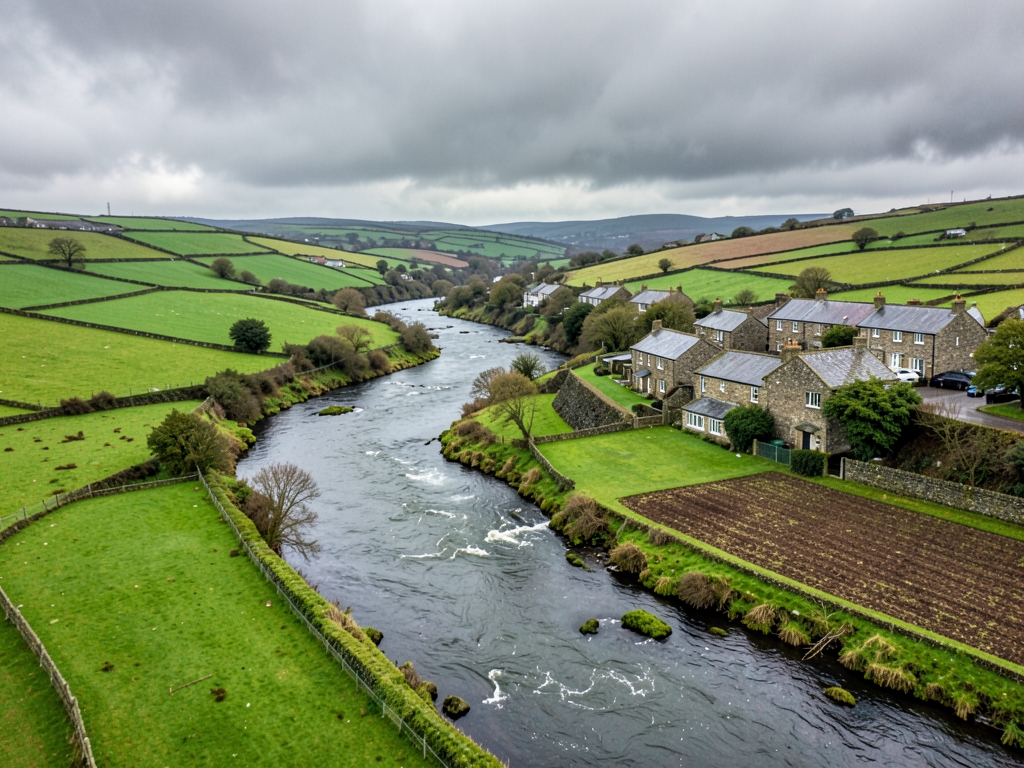
£850k Durham Unit
With the indicator confirmed, the second step turns to value-in-use arithmetic. The Durham unit carries a book value of £850,000. Annual net cash flow is assumed flat at £68,000, but a flood-zone insurance loading of £4,200 per year reduces the net operating benefit to £63,800. Discounting this stream at 7% pre-tax over a ten-year horizon yields an annuity value of approximately £448,000. This figure sits well below the carrying amount, creating a preliminary gap. However, the calculation is incomplete without adding a residual land-value assumption; once that component is included, the recoverable amount may bridge the gap and prevent an automatic write-down.
To finalize the test, the assessor must re-run the recoverable-amount calculation with the residual land value added back to the discounted cash-flow total. If the combined figure—discounted net cash flows plus residual land value—meets or exceeds the £850,000 carrying amount, the asset is not impaired; the flood-zone discount is merely reserved and disclosed. If the total falls short, the impairment is recognized. This re-test step is the decisive moment: it transforms a potential write-down into a targeted disclosure, ensuring the financial statements reflect the true economic impact of the 1-in-100 flood risk without overstating the asset’s vulnerability.
Decision Rules and Copy-Usable Checklist
Decision rule: if the flood-specific discount — insurance loading, void-period extension, and valuation adjustment taken together — is 5% or less of carrying amount, reserve with a disclosed sensitivity and do not impair. The reserve entry records the expected cost of the flood exposure; the disclosure states how recoverable amount moves if the discount widens. The 5% figure is the materiality floor applied in this analysis, not a threshold drawn from IAS 36 itself, and the working paper should say so.
Rule 3: if either value-in-use or fair value less costs of disposal falls below carrying amount after the flood adjustments, impair to the higher of the two — never to the lower, and never to the carrying amount less the discount as a shortcut. IAS 36 defines recoverable amount as the higher of fair value less costs of disposal and value-in-use, and the IFRS Foundation notes the standard requires disclosure of the recoverable amount of impaired assets where that amount is based on fair value less costs of disposal. Where the impairment is driven by climate-related exposure, KPMG's guidance on climate-related disclosures emphasizes clear, transparent, and connected disclosure of the impact on impairment testing.
The six-point verification checklist is the reusable artifact this section contributes. Before the file closes, confirm each point and initial it:
| # | Check | Evidence to attach |
|---|---|---|
| 1 | Postcode searched on the EA flood map at this reporting date | Dated map extract showing the band |
| 2 | Indicator logged in the IAS 36 register | Register entry with date and preparer |
| 3 | Discount components itemized: insurance loading, void extension, valuation adjustment | Broker quote and valuer note |
| 4 | Discount expressed as a percentage of carrying amount, arithmetic recomputed | Calculation sheet |
| 5 | Both recoverable-amount measures computed; higher one selected | Value-in-use and FVLCD workings |
| 6 | Outcome recorded: reserve with sensitivity, or impairment to the higher amount | Journal reference and disclosure draft |
Run the checklist in order and do not skip point 4: the 5% comparison is only as good as the arithmetic behind it, and a discount stated as a lump sum without a denominator cannot be tested against the floor. If any point cannot be evidenced, the file is incomplete and the indicator stays open.
Frequently Asked Questions
Can Flood Re be used to maintain affordable insurance for a commercial property in County Durham's 1-in-100 flood zone?
No, Flood Re does not cover commercial property, so a commercial County Durham asset in the 1-in-100 zone cannot rely on the scheme to keep cover affordable.
What happens to a property's cash-flow projections if insurers withdraw entirely from the market?
The property's cash-flow projections lose the assumption of insurable operation, and value-in-use can fall below the 5% floor's protection.
How should the no-insurance scenario be modelled in the impairment assessment?
The no-insurance scenario must be built as its own cash-flow case, with the resulting recoverable amount compared against carrying value on its own terms.
If flood risk is surface-water-only and does not appear as fluvial exposure on the Environment Agency map, what is the likely outcome for the flood-zone discount?
The flood-zone discount evidence, once verified, is more likely to sit below the 5% floor.
In the surface-water-only risk scenario, does the impairment test result in a write-down?
No, the reserve-and-disclose treatment holds, and the impairment test is documented as performed with the indicator not escalating to a write-down.
Why is it critical to identify which edge case a property falls into before calculating recoverable amount?
Because the table determines whether the 5% floor is even the right test, and applying the floor to a no-insurance commercial asset applies the wrong rule to the right indicator.
Quick answers
| Why can a commercial County Durham asset in the 1-in-100 zone not rely on Flood Re to keep cover affordable? | Flood Re does not cover commercial property. |
| What happens to a commercial property's cash-flow projections if insurers withdraw entirely from the 1-in-100 zone? | The property's cash-flow projections lose the assumption of insurable operation, and value-in-use can fall below the 5% floor's protection. |
| What is the consequence of applying the 5% floor to a no-insurance commercial asset? | It applies the wrong rule to the right indicator. |
| How should surface-water-only risk that does not register as fluvial exposure on the Environment Agency map be treated? | The flood-zone discount evidence, once verified, is more likely to sit below the 5% floor, and the reserve-and-disclose treatment holds, with the impairment test documented as performed and the indicator not escalating to a write-down. |
| What must be recorded before the recoverable-amount calculation begins for a property in the 1-in-100 zone? | which edge case the property falls into |
Also worth reading: Performance Obligation Bundling Under IFRS 15 A 2024 Technical Analysis for Financial Auditors: Performance Obligation Bundling Under IFRS · How internal controls strengthen your financial reporting: How internal controls strengthen your · Audit anomaly scores explained: 5% flagged means expand testing: Audit anomaly scores explained: 5%